
Unheard Voice provided independent research for this report
On 16 November 2026, Mission 44 published Igniting Inclusion: Progress and Recommendations, Five Years On from the Hamilton Commission. I’m proud to be its lead author, alongside Cara Cinnamon of Mission 44, and to have led the independent research and analysis behind it through Unheard Voice Consultancy.
The question at the heart of it
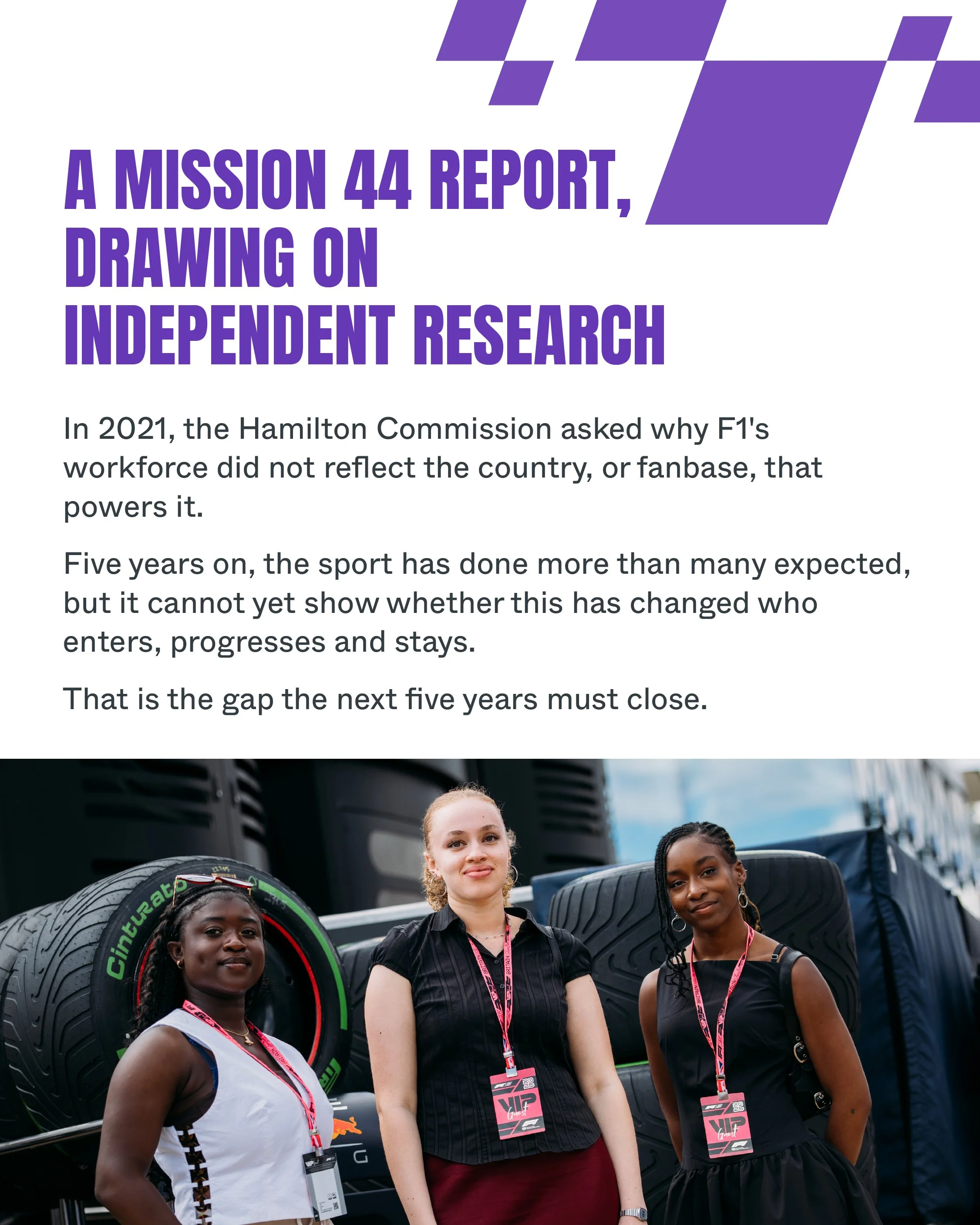
In 2021, the Hamilton Commission asked a simple question: how many Black people work in motorsport? Five years on, the sport still can’t say how that number has changed.
There has been real progress. Formula 1, the FIA and all the teams have signed a Diversity and Inclusion Charter. Scholarships are opening routes into engineering, and the MSc Motorsport Scholarship has been independently evaluated. A generation of young people can now picture themselves building a career in Formula 1.
But there is still no shared data on who joins, who is promoted and who leaves. Teams define under-represented groups differently, so even where numbers exist, they can’t be compared. The sport can count its reach. It can’t yet count its progress.
What the research involved
The research brought together 34 interviews, 18 of them in-depth with young people and 16 with stakeholders and sector leaders, including people inside Formula 1 teams. Alongside them sat a lived-experience consultation with 60 people with a connection to STEM, engineering and motorsport, and analysis of team data, gender pay gap reporting and the sport’s own published reporting. The evidence base also draws on a national youth survey of 3,021 young people and a three-market survey of 3,000 Formula 1 fans.
What people told us
68% knew nobody who could open a door for them. Among Black respondents, 92%.
60% said the cost of applying was a barrier, rising to 81% among those from lower-income backgrounds.
38% had left a course, or seriously considered leaving a programme or job, because of how they were treated.
Only 35% felt they belonged, and 23% of Black respondents.
One engineering vacancy attracted almost 8,000 applications, and young people described repeated rejection by automated screening, often without feedback.
Three recommendations
The report asks Formula 1, the FIA and all 11 teams to:
Prove it, share it. Report the same facts each year to an independent data partner, which publishes one sport-wide picture of who joins, progresses and leaves.
Fund it. Take talent investment out of the cost cap, starting with apprentice salaries, and invest at least £50 million of new money over five years.
Open the door. Commit every team to a published number of paid, accessible early-career places each year, with automated screening tested for bias and its use disclosed.
Why this matters beyond motorsport
In every sector I work with, I see the same pattern: plenty of activity and plenty of goodwill, but little infrastructure to show whether any of it is changing who gets in, who gets on and who stays. An unmeasured culture is an unmanaged risk. Averages can tell you all is well while the people furthest from the centre quietly walk out of the door.
To every young person, scholar, team leader, educator and partner who gave their time and their honesty to this research: your voices are the evidence. Thank you. My thanks too to Cara and the Mission 44 team, and to Sir Lewis Hamilton, for keeping this question on the grid.
Read the full report on the Mission 44 website
If you’d like to know whether your organisation’s inclusion work is changing who joins, who progresses and who stays, I’d be glad to talk.
